
Transformers are important parts of electrical power systems. They change voltage from one level to another and help electricity reach buildings, factories, machines, and other equipment safely.
Two common transformer types are oil-immersed transformers and dry-type transformers. Both can provide reliable power, but they use different insulation and cooling methods. They are also suitable for different working environments.
Understanding these differences can help you choose the right transformer for your project.
What Is an Oil-Immersed Transformer?
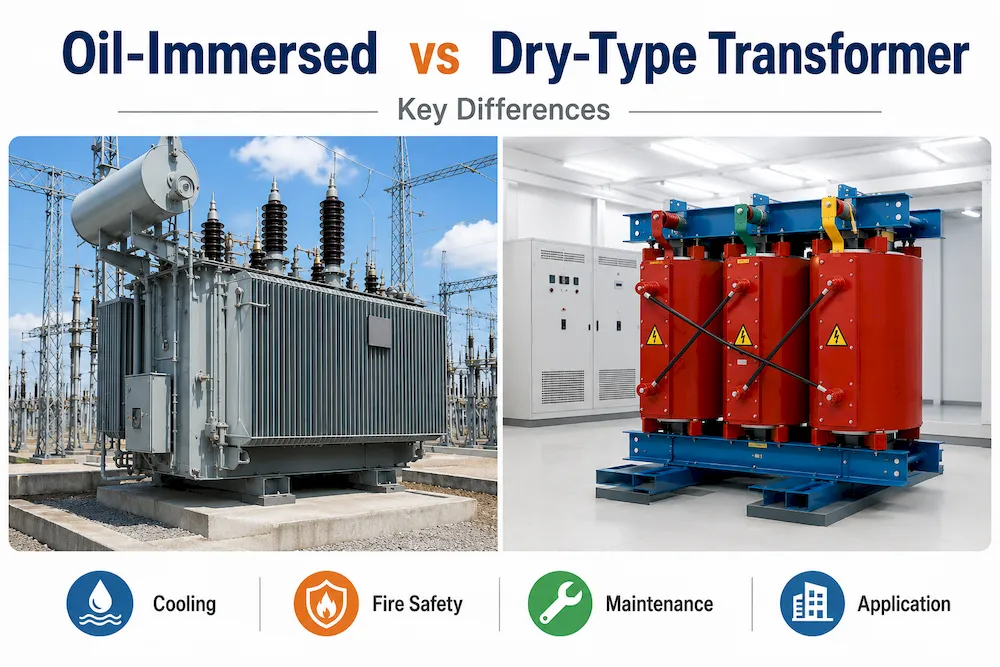
An oil-immersed transformer uses special insulating oil inside the transformer tank. The oil provides electrical insulation and also helps remove heat from the transformer.
The transformer core and windings are placed inside a sealed metal tank filled with oil. During operation, the oil absorbs heat and transfers it to the tank and cooling radiators.
Oil-immersed transformers are widely used in:
- Power substations
- Utility networks
- Industrial factories
- Solar and wind power projects
- Mining sites
- Outdoor distribution systems
- Large infrastructure projects
Main Advantages of Oil-Immersed Transformers
Oil-immersed transformers usually have strong cooling performance. This allows them to work at higher power levels and handle larger loads.
Their main advantages include:
- Good heat dissipation
- Suitable for high capacity
- High insulation strength
- Reliable performance
- Long operating life
- Suitable for outdoor installation
- Lower cost for many large-capacity projects
Because of these advantages, oil-immersed transformers are common in medium-voltage and high-voltage power systems.
Main Limitations of Oil-Immersed Transformers
The insulating oil also creates some special requirements.
Oil-immersed transformers may need:
- Regular oil inspection
- Leakage prevention
- Fire protection
- Oil collection systems
- More maintenance
- Environmental protection measures
If the transformer is installed inside a building, the project may require fire walls, oil pits, ventilation, or other safety systems.
What Is a Dry-Type Transformer?
A dry-type transformer does not use insulating oil. It normally uses air and solid insulation materials to cool and protect the windings.
Many dry-type transformers use cast resin to cover the windings. This design helps protect the transformer from dust, moisture, and other environmental conditions.
Dry-type transformers are often used in:
- Office buildings
- Shopping centers
- Hospitals
- Schools
- Data centers
- Airports
- Tunnels
- Factories
- Residential buildings
- Indoor substations
Main Advantages of Dry-Type Transformers
Dry-type transformers are often chosen for indoor locations because they do not contain flammable transformer oil.
Their main advantages include:
- Lower fire risk
- No oil leakage
- Cleaner operation
- Less routine maintenance
- Suitable for indoor use
- Easier installation near electrical loads
- Better choice for public buildings
Dry-type transformers can be installed closer to the equipment they serve. This may reduce cable length and power loss.
Main Limitations of Dry-Type Transformers
Dry-type transformers also have some disadvantages.
They may have:
- Higher purchase cost
- Lower cooling ability than oil-filled units
- Larger size for the same capacity
- More noise in some applications
- Greater sensitivity to dust and humidity
- Limited capacity for some projects
Dry-type transformers also need good ventilation. If the surrounding temperature is too high, the transformer may not cool correctly.
Oil-Immersed Transformer vs Dry-Type Transformer
The biggest difference is the insulation and cooling method.
An oil-immersed transformer uses insulating oil. A dry-type transformer uses air and solid insulation.
This difference affects cost, safety, maintenance, installation, and performance.
Cooling Performance
Oil is very effective at carrying heat away from the transformer windings. For this reason, oil-immersed transformers are often better for high-capacity and heavy-load applications.
Dry-type transformers usually depend on natural air cooling or forced-air cooling. They are suitable for many commercial and industrial projects, but they may need more space and ventilation.
Fire Safety
Dry-type transformers have a lower fire risk because they do not contain transformer oil. This makes them suitable for hospitals, schools, shopping centers, high-rise buildings, and other indoor locations.
Oil-immersed transformers require stronger fire protection. However, they can still operate safely when they are designed, installed, and maintained correctly.
Maintenance
Oil-immersed transformers need oil testing and regular inspection. The operator should check the oil level, oil quality, seals, cooling system, and possible leakage.
Dry-type transformers normally need less maintenance. However, they still require cleaning, temperature checks, connection inspections, and ventilation checks.
Cost
Oil-immersed transformers are often more economical for large-capacity projects. They can provide strong performance at a lower initial cost.
Dry-type transformers often have a higher purchase price. However, they may reduce the cost of fire protection, oil control systems, and maintenance.
The final cost depends on the full project, not only the transformer price.
Installation Environment
Oil-immersed transformers are commonly installed outdoors or in special transformer rooms.
Dry-type transformers are commonly installed indoors, especially close to buildings and sensitive equipment.
For outdoor use, a dry-type transformer may require a weatherproof enclosure and stronger environmental protection.
How to Choose the Right Transformer
The best transformer depends on your project conditions.
Choose an oil-immersed transformer when:
- The required capacity is high
- Strong cooling is important
- The transformer will be installed outdoors
- The project has enough space
- Lower initial cost is important
- Fire protection systems can be installed
Choose a dry-type transformer when:
- The transformer will be installed indoors
- Fire safety is a major concern
- Oil leakage is not acceptable
- The site is near people or sensitive equipment
- Low maintenance is important
- Space for an oil collection system is limited
Other Factors to Consider
Transformer type is only one part of the selection process. You should also confirm:
- Rated capacity
- Primary and secondary voltage
- Frequency
- Number of phases
- Vector group
- Impedance
- Tap changer type
- Cooling method
- Noise requirements
- Protection level
- Installation altitude
- Ambient temperature
- Required standards
- Testing requirements
A professional transformer manufacturer should review these details before providing a final solution.
Conclusion
Oil-immersed transformers and dry-type transformers both have important advantages.
Oil-immersed transformers provide strong cooling, high capacity, reliable performance, and competitive cost. They are commonly used in outdoor substations, industrial projects, and power networks.
Dry-type transformers provide lower fire risk, cleaner operation, and easier indoor installation. They are often used in buildings, hospitals, data centers, and other places where safety is very important.
There is no single transformer type that is best for every project. The right choice depends on the load, installation location, safety requirements, maintenance plan, budget, and local standards.
Before ordering, provide complete technical and environmental information to the transformer supplier. A careful review will help you choose a safe, efficient, and reliable transformer for long-term operation.